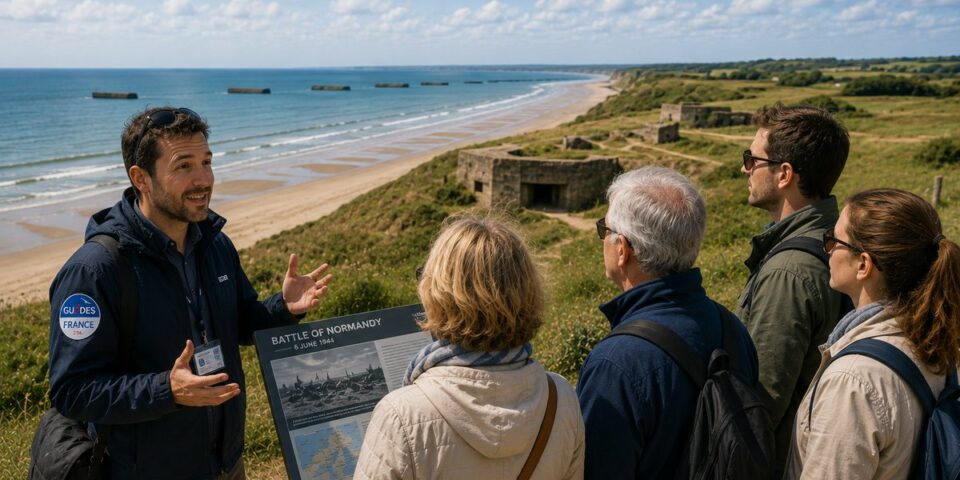
battle of normandy tour group
The Battle of Normandy and Operation Overlord

The Battle of Normandy : Book your guide to discover the history

The Battle of Normandy was one of the most decisive military campaigns of the Second World War and marked the beginning of the liberation of Western Europe from Nazi occupation. It began with Operation Overlord on 6 June 1944, better known as D-Day, when Allied forces launched the largest amphibious invasion in history along the Normandy coast of France.

Operation Overlord had been planned for many months by Allied commanders, including General Dwight D. Eisenhower, Supreme Commander of the Allied Expeditionary Force. The objective was to establish a secure foothold in Nazi-occupied France, allowing Allied armies to advance towards Germany and ultimately bring an end to the war in Europe.

The Landing Beaches

In the early hours of 6 June 1944, more than 156,000 Allied troops from the United States, the United Kingdom, Canada, and several other Allied nations crossed the English Channel. They were supported by over 5,000 ships, thousands of landing craft, and nearly 11,000 aircraft. Before the beach landings began, more than 24,000 American, British, and Canadian airborne soldiers parachuted behind enemy lines to capture bridges, destroy communications, and prevent German reinforcements from reaching the beaches.

The invasion took place across five designated landing sectors: Utah, Omaha, Gold, Juno, and Sword Beaches. Each beach presented different challenges. American forces encountered fierce resistance at Omaha Beach, suffering heavy casualties before eventually securing the area. Utah Beach proved more successful thanks to lighter German defences and the support of airborne troops. British forces landed at Gold and Sword Beaches, while Canadian troops fought bravely at Juno Beach, advancing further inland than any other Allied force on D-Day.

Although the landings themselves were a remarkable achievement, they marked only the beginning of the campaign. The Battle of Normandy continued for almost three months as Allied forces fought their way through the region’s difficult bocage countryside, characterised by dense hedgerows, narrow lanes, and fortified villages. These natural obstacles heavily favoured the German defenders, slowing the Allied advance and leading to intense fighting throughout June and July 1944.

Key Battles

Several key battles shaped the campaign. The city of Caen, one of the main Allied objectives, became the focus of prolonged fighting between British, Canadian, and German forces. To the west, American troops gradually pushed south before launching Operation Cobra in late July, breaking through German defensive lines near Saint-Lô. This breakthrough allowed Allied forces to advance rapidly across France.

By August 1944, German forces found themselves trapped in what became known as the Falaise Pocket, where Allied armies surrounded large sections of the German Seventh Army. Although some German troops escaped, the battle inflicted devastating losses on Germany’s military strength in France and effectively ended organised resistance in Normandy.

The Success of the Battle of Normandy

On 25 August 1944, Allied forces liberated Paris, just weeks after breaking out of Normandy. The success of Operation Overlord and the Battle of Normandy established a permanent Western Front in Europe and significantly accelerated the defeat of Nazi Germany, which surrendered less than a year later on 8 May 1945.

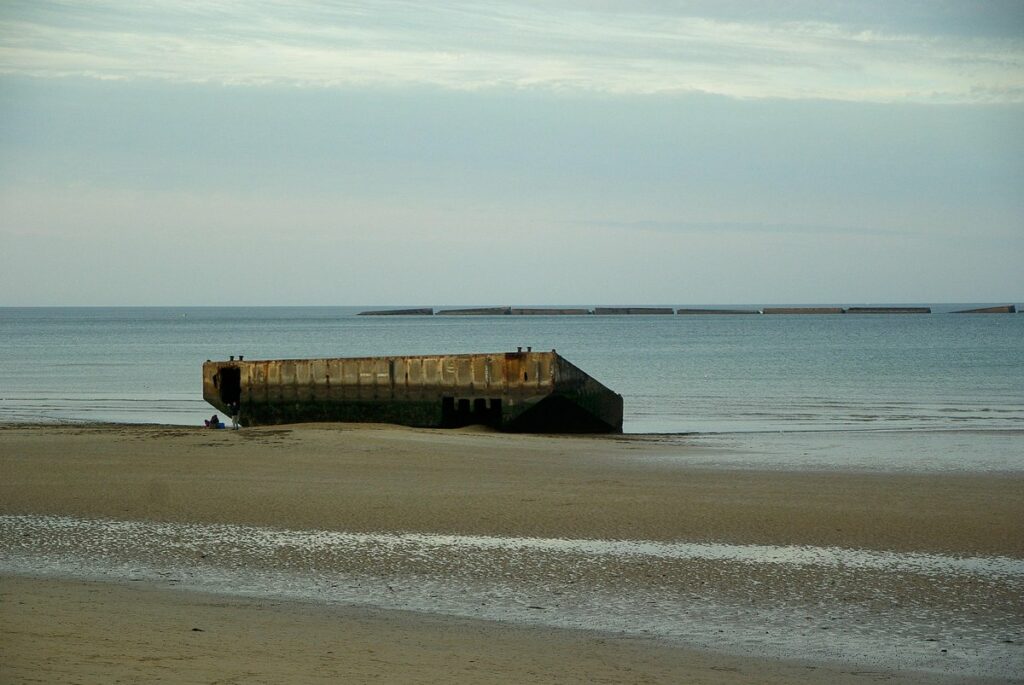
Today, Normandy remains one of the world’s most important destinations for military history. Visitors can explore the five landing beaches, wartime bunkers, museums, memorials, military cemeteries, and preserved battlefields that tell the story of this extraordinary campaign. Sites such as Omaha Beach, Pointe du Hoc, Pegasus Bridge, Sainte-Mère-Église, Arromanches, and the Normandy American Cemetery provide powerful reminders of the courage, sacrifice, and international cooperation that helped restore freedom to Europe.

Visiting the Battle of Normandy sites is more than a history lesson—it’s an opportunity to honour the thousands of soldiers, sailors, airmen, and civilians whose bravery changed the course of history. Whether you explore independently or with a knowledgeable private guide, the Normandy battlefields offer an unforgettable insight into one of the defining events of the twentieth century.

Leave a Reply

Your email address will not be published. Required fields are marked *

X